Wednesday, 20 May 2020

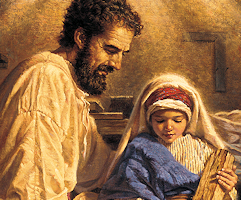
'Saint Joseph and the Word'


Saint Joseph and the Word

Saint Joseph was the most silent saint of all.
No one has written down one word of his
for our edification. Not one small
word of his was saved unless it is
the Word that was the sum of all his life,
the precious Word he saved for everyone
that It might speak the cross and not the knife,
long, long after he was dead and gone
and gathered to his fathers, and never again
could he spirit the Child and the young girl, his mother,
out of the dangerous city.  From all men
of all times he was chosen and no other –
not one from among the prophets – but this rarely heard
and wordless man, to save God’s mighty Word.

                                                                        Sister Maris Stella
                                          (ack. ‘The Mary Book’. Sheed & Ward. 1950)

                                                    *************

   'A Carpenter's Son'


He was a carpenter’s son, from Nazareth.

            I wish to begin with the utmost simplicity, and by saying that this was true.  True in the sense that Our Lord was truly man and, legally, the son of Joseph.

            When a Jewish girl was solemnly betrothed to a Jew, she became legally under his protection and passed out of her father’s control, even if she did not leave her father’s house.  When Our Lady was betrothed to St. Joseph by law she was responsible to him, and he for her.  I will ask you, though, only for one moment, to consider the appalling hour during which St. Joseph perceived that she would be the mother of a child who was not his own.  Strictly speaking, it was his duty to hand her over to the law, and it was the duty of the terrible Jewish authorities to cause her to be stoned.  Such was the agonising preface to the history of Our Lord, agonising, need I say, not only to St. Joseph but to the immaculate Virgin Mother of God.  But the incredible purity of Mary had diffused its fragrance around herself:  Joseph was, the Gospel says, a ‘just’ man, he knew by instinct that, whatever had happened, there could be no imaginable taint in her whom by now he appreciated sufficiently to know that at least, and he was making arrangements to send her quietly away, so that no-one should hear about what had happened.  Then it was that God Himself let the mind of this simple working man know that he need have no fear;  he kept Mary with him and he assumed full paternity, in the eyes of the world, of the child that was born; and legally, and in every way that human society could perceive and accept, he ranked himself as father of her child, and never did Jesus, during His childhood, adolescence, or afterwards, do anything which could humiliate or disconcert St. Joseph.  I beg of you to delve into this episode so little spoken of, and to venerate the persons who went through so really dreadful an experience.  But it is not of the legal and social parenthood or humanity of Christ that I wish now to speak.

            Jesus Christ could not in any sense have been called son of Joseph had He not been truly man.  It would have been an illegitimate fiction, a wanton delusion, so to call Him, had He been anything short of it. But to be a man involves at least your being partly body.  A body is not a thing you  ‘have’, but a thing you are.  We are not body plus soul, soul in spite of body, soul inside a body, but persons, body-souls.  Our Lord grew.  He  ‘increased in stature’ say the Evangelists.

            He was a baby, Christmas does not allow us to forget that; if you had met Him then, you would not have been able to do towards Him more than you can towards any lovable little baby that looks at you with its blue whites to its eyes and catches hold of your thumb with its incredibly strong miniscule fingers ending in pink nails so tiny as to be almost laughable.  You cannot say anything to such a baby; you can do nothing but love it; but it always knows if you do. He was a little boy, and you know how very little boys will trust you, take you for granted, never begin to dream that you are going to be unkind to them, instinctively sheer away from you if you begin taking airs or putting on affectations towards them, are very hurt if you do not accept their views of things exactly in the way they accept them. Little boys can be made very lonely if you act the aloof grown-up, but far more  lonely if you act as a child, which they know very well you are not.  Jesus was next a growing lad, and only for one moment is the curtain lifted upon those years, during an episode of three days, when, upon the occasion of a pilgrimage to Jerusalem, He stayed behind and was lost to Mary and to Joseph. They found Him, and thereafter, His history relates, He stayed at Nazareth, being ‘subject unto them’.  He learned and gradually performed His work as smith and carpenter in a town which, though small, was a very active one. Nazareth lay near two roads, up and down which trade flowed continuously and also the Roman soldiery, and also the caravans taking people to and from the summer-court of Herod Antipas at Sephoris.  When Our Lord was about ten, He, and all the folk of Nazareth, watched that town on its hill four miles away going up in smoke when the Romans, because of an abortive insurrection, burnt it; those Romans crucified two thousand men of the neighbourhood as an object lesson.  Mary could not go to her well, nor Jesus to the social meeting place of any oriental town, the Gate, without seeing, or trying not to see, poor human corpses rotting upon crosses.  He knew, perhaps  she dreamed what was to happen after twenty years, not away in Galilee, but in Jerusalem, the holy city, the dear city, which yet should crucify its Lord.

                                                                                                                                                                                      C.C.Martindale,  S.J.
                 
        (ack.  ‘The Book of the Saviour’.  Sheed & Ward.  1952.)

                                                                                                                                                                                                                *************************

 ‘Thoughts on St. Joseph’

            Dear Friend,

            You ask me to talk to you from time to time and tell you what my mind is full of.  Well, what fills it at the moment is that great and rather mysterious figure, St. Joseph, whose very name provokes a smile from superior persons. He was at once a workman and a gentleman. He was cheerful and silent, with a big noble nose, muscular arms and hands, with one finger often wrapped in rag, as is the way with those who labour in wood. He was not popular with Nazareth folk, they scarcely are who follow a peculiar calling.

            And  what more singular for a man than virginity, especially at that period?  Why had he taken it on himself? How patient he must have been and strong against boredom, like the sun beginning the same round every morning

without weariness.

            I see him on an autumn day coming back from Caiffa  where he went to fetch timber in a broken-down cart. I see him crossing the Sizon at the spot where the plain of Esdraelon unfolds before you, up to the trans-Jordanian mountains, the territory of six of the tribes.  The cart sinks to its axles in the mud.

            Then I see him in his workshop on a sunny morning. I hear the saw and hollow noise of balks of timber, and a child coming to look for him and calling  “Joseph, Joseph” (perhaps that has some bearing one way or another on his departure for Jerusalem).  His workshop must have been dear to children, as joiner’s workshops always are.

            Next I see him coming back from Jerusalem with his Bride so young and gentle (not much more than he beloved by the townfolk):  I see them landing at home, and the obliging neighbour who had been getting the household ready; the remarks about it all at the well that evening.

            Joseph is the pattern of the hidden life, Scripture does not report a single word of his, it is silence who is father to the Word. What contrasts are in him! He is the patron of bachelors and of fathers of families, of laymen and contemplatives, of priests and business men!  For Joseph was a carpenter. He had to argue with customers and sign small contracts; to follow up bad debts, to plead, to compromise, to buy his goods cheapest while ruminating on the second-hand, and so on.

            How touching must have been his last days of failing health, between Jesus and Mary, when he could no longer work! I see the coachman of one of those fine ladies who went to the waters at Tiberias,  drawing up at the sick carpenter’s to get the carriage mended.  Jesus Himself takes it over and takes the tools from his hands.

            All this goes on without a word when the Roman Empire was at its zenith, full of pride and crime like our present civilisation. It is neither Caesar nor Plato. Here are only three poor folk loving one another, and they are going to change the face of the world. It all goes on at the foot of a round mountain called Tabor; and in the distance is seen the long summit of Carmel. The villages nearby are called Cana, Nahum, Endor, Mageddo.  In three hours you get the brilliant country round the Lake of Genezareth, which was then what Aix-les-Bains is today, but now lonely and unpeopled!


                                   Paul Claudel,  Prague 1932.

                       (ack. ‘The Mary Book’. Sheed & Ward.1950)

                                                     ****************


                                  The Crucifixion    -   Mathias Grunewald


‘Through Thy Cross and Passion’


 O Christ my Lord which for my sins didst hang upon a tree,

grant that thy grace in me poor wretch, may still engrafted be.


Grant that thy naked hanging there, may kill in me all pride

and care of wealth, sith thou didst then in such poor state abide.


Grant that thy Crown of pricking thorns which thou for me didst wear,

may make me willing for thy sake all shame and pain to bear.


Grant that those scorns and taunts which thou didst on the cross endure,

may humble me, and in my heart all patience still procure.


Grant that thy praying for thy foes may plant within my breast,

such charity as from my heart  I malice may detest.  


Grant that thy pierced hands which did of nothing all things frame,

may move me to lift up my hands, and ever praise thy name.


Grant that thy wounded feet  whose steps were perfect evermore,

may learn my feet to tread those paths which thou hast gone before.


Grant that thy bitter gall which did thy empty body fill,

may teach me to subdue myself and to perform thy will.


Grant that thy wounds may cure the sores which sin in me hath wrought,

grant that thy death may save the soul which with thy blood was bought.


Grant that those drops of blood which ran out from thy heart amain,

may meek my heart into salt tears to see thy grievous pain.


Grant that thy blessed grave wherein thy body lay awhile,

may bury all such vain delights as may my mind defile.


Grant that thy going down to them which did thy sight desire,

may keep my soul when I am dead, clean from the purging fire.


Grant that thy rising up from death, may raise my thoughts from sin,

grant that thy parting from this earth, from earth my heart may win.


Grant Lord that thy ascending then, may lift my mind to thee,

that there my heart and joy may rest, though here in flesh I be.


                                        Blessed Philip Howard

                                           
       (ack. ‘The Book of the Saviour’, Sheed & Ward, 1952.)

Friday, 20 March 2020

'Love of the Saints for the Passion'


The following article is taken from 'Meditation on the Passion' compiled from Various Sources by Rev. Reginal Walsh O.P., published by Burns, Oates, and Washbourne Ltd., London,. 1922.


                    Jesus Christ in the Garden of Gethsemane 
                        - Heinrich Hofmann1886 (Wikipedia)


In the Introduction to this book Fr Walsh has this to say:-

‘Among the many subjects proposed by the Church to us for mental prayer, there is none more  profitable than the sublime mystery of Calvary. For even where everything is supremely holy – namely, in the actions of Him Who is the way, and the truth, and the life – the Passion is the culmination of sanctity, the highest exercise of virtue, the greatest cause of merit.  Hence devout meditation on it produces most abundant fruit in souls. And for this reason, Saints and Doctors of the Church – those who are specially enlightened, those who spoke from experience, those who are our best guides in the spiritual life – with one accord praise and glorify it.

                For instance, St. Jerome says: “In the Passion all the other mysteries are contained.”  St. Augustine speaks as follows: “There is nothing more advantageous , nothing better adapted to ensure our eternal salvation, than daily to contemplate the sufferings which Jesus Christ bore for our sake.”  And St. Leo the Great expresses himself thus: “The cross of Christ is the source of every blessing, the fountain of all merit: to the faithful it gives strength from His weakness, glory from His shame, and life from His death.”

                If at the present day countless human beings live as thoughtlessly and carelessly as if their souls had not been redeemed, as if they had not been bought at a great price, surely it becomes our duty to make reparation for their indifference and ingratitude.  In proportion to the world’s forgetfulness should be our remembrance.  This solemn obligation rests on us all as Catholics.  We must not be heedless, we who are familiar with the words: “In the cross is salvation; in the cross is life; in the cross is protection from thy enemies.  In the cross is the infusion of heavenly sweetness; in the cross is strength of mind; in the cross is joy of spirit.”

                It is hoped that they who love to contemplate and consider what the Word Incarnate suffered for their salvation will find this work useful. Here, in passing, we may say that the Meditation now presented to all was in its first shape designed and destined for private circulation only.

                A Member of the Institute of the Blessed Virgin Mary, who, as Mistress of Novices for about thirty years, had gained great experience in the formation of religious as well as in the varied requirements of conventual life, proposed by means of this book to impart to her Sisters the fruit of her own reflections on the Passion, which one so spiritual and enlightened ws exceptionally fitted to compile.

                As might have been anticipated, the excellence of the work, which she had intended for the use of her Sisters, in course of time became known to several persons, in one or other way connected with the Institute of the Blessed Virgin.  And among them, some are of opinion that this treasure should no longer be allowed to remain almost hidden in the cloister.  They have represented that outside the convents of the Institute there are many devout souls to whom the Meditation would be most acceptable. In accordance with their suggestion, and in compliance with their wish, it is now reprinted.

                But in order to increase its utility, so far as persons living in the world are concerned, many passages in the work, as it appeared at first, have been omitted – those, namely, which were addressed to nuns as such; also some other incidental clauses have been either omitted or else slightly c hanged.  This remark will suffice to explain the difference which, as any person who compares them cannot fail to observe, exists here and there between the original and the revised edition.

                That the book may continue to be a help to advancement in the spiritual life, and become an abundant source of blessings to a still wider circle of readers, is the earnest desire of those who have had to do with its reissue.

                                                                                                                                                         Reginald Walsh, O.P.


         Way to Calvary  -  Andrea di Bartolo 1400 (Wikipedia)


Love of the Saints for the Passion

A certain devout solitary prayed to God to teach him what he could do in order to love Him perfectly.  Our Lord revealed to him that there was no more efficient way to arrive at the perfect love of Him than to meditate constantly on His Passion.  St. Teresa lamented and complained of certain books which had taught her to leave off meditating on the Passion of Our Lord,  because this might be an impediment to the contemplation of His Divinity; and the Saint exclaimed;  “O Lord of my soul, O my Jesus Crucified, my treasure, I never remember this opinion without thinking that I have been guilty of very great treachery . And is it possible, Thou my Lord, couldst be an obstacle to me in the way of a greater good?  Whence, then, do all good things come to me, but from Thee?”  And she added: “I have seen that in order to please God, and to induce Him to grant us great graces, He wills that they should all pass through the hands of this most sacred Humanity, in which His Divine Majesty declared He took pleasure”.

                For this reason, Father Balthazar Alvarez said, that ignorance of the treasures we possess in Jesus was the ruin of Christianity; and therefore his most favourite and usual meditation was on the Passion of Jesus Christ.  He meditated especially on three of the sufferings of Jesus – in poverty, in contempt, and pain; he exhorted his penitents to meditate often on the Passion of Our Redeemer, telling them that they should not consider that they had done anything at all, until they had arrived at retaining Jesus Crucified continually present in their hearts.  “He who desires,” says St. Bonaventure,  “to go on advancing from virtue to virtue, from grace to grace, should meditate continually on the Passion of Jesus.  And,” he adds, “that there is no practice more profitable for the entire sanctification of the soul than the frequent meditation on the sufferings of Jesus Christ.”

                St. Augustine tells us that a single tear shed at the remembrance of the Passion of Jesus is worth more than a Pilgrimage to Jerusalem, or a year of fasting on bread and water. Because it was for this end that Our Lord suffered so much, in order that we should think of His sufferings; for, if we think on them, it is impossible not to be inflamed with divine love: “The charity of Christ presseth us,” says St. Paul. Our Lord is loved by so few, because few consider the pains He has suffered;  but he that frequently considers them cannot live without loving Jesus.  “The charity of Christ presseth us” – we shall find ourselves so constrained by His love that we shall not find it possible to refrain from loving a God so full of love, who has suffered so much to win our love.

                Therefore St Paul said that he desired nothing but Jesus, and Jesus Crucified – that is, the love that Our Lord has shown us on the Cross: “I judged not myself to know anything among you but Jesus Christ, and Him crucified”(1Cor.11.2). And, in truth, from what book can we better learn the Science of the Saints – that is the Science of loving God – than from Jesus Crucified! That great servant of God, Brother Bernard of Corleone, the Capuchin, not being able to read, his brother religious wanted to teach him, upon which he went to consult his crucifix; but Jesus answered him from the Cross: “What is reading?  What are books?  Behold I am the book wherein thou mayest continually read the love I have borne thee.”  O great subject to be considered during our whole life; and during all eternity.  A God dead for love of me!  A God dead for love of me!  A wonderful subject!

                St. Thomas Aquinas was one day visiting St. Bonaventure, and asked him from what book he had drawn all the beautiful lessons he had written. St. Bonaventure showed him the image of the Crucified, which was completely blackened by all the kisses that he had given it, and said: “This is my book whence I receive everything that I write; and it has taught me whatever little I know.”  It was this sweet study of the crucifix which made St.Francis become a great seraph.  He wept so continually  in meditating on the sufferings of Jesus Christ, that he almost entirely lost his sight.  We fancy sometimes as we read the Lives of the Saints, that it was easy enough for them to have an intense devotion to the Passion, since they were, at least many of them, favoured with such sensible graces and miraculous favours. Take, for example, Blessed James of Bevagna, from whose crucifix flowed a stream of miraculous blood, as he knelt before it, while a voice issued from it, giving him the assurance of his salvation. How could he ever again have looked upon his crucifix without realizing the love of his Divine Master in pouring out that Precious Blood for the salvation of the human race?   Or again, when the crucifix spoke to St Peter Martyr, in his hour of trial, and said:  “And I, Peter, what had I done?” How easy for him to draw the lesson of patience and resignation under calumny!  But we forget that these and other similar favours were but exterior signs of God’s grace and love; and that, before the Saints received them, they had long practised devotion.  Look at the life of any Saint you like, and you will find an extraordinary devotion to the Passion.  It was the distinguishing mark of the Saints; they would not have been Saints without it.

                But apart from the miraculous graces vouchsafed to the chosen servants of God, something of the same kind has happened to ourselves hundreds of times in the course of our lives.  Who can say that the crucifix has never spoken to him? – spoken in times of trial, of temptation, of difficulty? – I will not say calumny, but when a breath has risen up against us, and we have been tempted to maintain our dignity, stand up for our rights and what we thought was due to us? – as we cast our eyes upon the crucifix, has it not spoken to our hearts; has it not reproved us;  and said in an almost audible voice: I did not act thus!  Does it not teach us the same lessons it taught the Saints, only not in the same sensible way?  Oh, how many times the crucifix has spoken to us and given us courage and grace which have enabled us to bear the trials that surround us. It is not necessary for us to see, and hear, and feel these things as the Saints did. We need not desire to see with St. Catherine and many of the Saints the scenes of the Passion in a sensible form in our imagination, or wish to go in spirit with the venerable Anne Emerich to the spot where our Divine Lord suffered and died; for we have all these things and more than this. Though they were miraculous graces, they were but representations; we have the reality. Every morning at Mass, we assist, not at the representation, but at the renewal of the tremendous sacrifice on Calvary  and the mystic outpouring of that Most Precious Blood. The blood which flowed from Bl. James’s crucifix was only miraculous blood; but in the Mass we have the same Precious Blood poured out anew as on Calvary itself; the Sacred Body is broken again for us, and in Holy Communion which we receive so often, is given into our very hearts, while our lips are dyed with the most Precious Blood of the Crucified.


         Christ on the Cross  -  Carl Heinrich Bloc 1870 (Wikipedia)


 In order, then, that we may understand and reverence and love the 

Sacred Passion of Our Lord, let us, with an ever-increasing love, 

fervour and attention, apply ourselves to the study and 

contemplation of each mystery of His suffering life- strive to attain 

closer union with our Lord through His Passion.  Let us make our 

hearing of Holy Mass an act of special devotion to the Passion – 

such as it would have been actually on Mount Calvary with Mary, 

the Mother of Sorrows.  When receiving Holy Communion let us 

approach with greatest love the Sacrament of love, that, becoming 

more and more united with Jesus, our dear Lord, we may be able 

share also in His sufferings. St. Gertrude says beautifully, that, “as 

no-one can handle flour without carrying some of it about with her, 

so no one can meditate devoutly and assiduously on the Passion 

without deriving great fruit therefrom.”  As Gertrude was on one 

occasion occupied in considering the Passion of our Lord  it was 

made known to her that there is infinitely more merit in meditating 

on the Passion of Jesus than in any other exercise.  And when 

anyone reads anything concerning the Passion they at least dispose 

their souls to receive the fruits of it, as it is more meritorious to 

meditate on it than on any other subject. Let us therefore 

endeavour  to reflect on it constantly that it may be honey to our 

lips, music to our ears, and joy to our hearts.                                                                                                                 

Saturday, 18 January 2020

'Mrs Peabody's Present' - a Christmas story.


We are still in the period of Christmastide, and it seemed a good idea to post another short story from that delightful book ‘The Seven Deadly Virtues and Other Stories’, written by Fr Bernard Basset S.J. in or about the 1950s.  ‘Mrs Peabody’s Present’, emphasises a particular aspect of the Christmas story, which is  recognised by all Christians, but which is also so easy to overlook.

I hope that you enjoy it as much as I do.


                                            ***************


Mrs Peabody’s Present


The quickest and safest way to Mrs Peabody’s sweet-shop was to cut down the little alley behind the grocer’s and then take the second turning on the right.  There was another, more respectable route via Warwick Street, but this took longer and carried with it the risk of being recognised..  Once in the alley one was safe from adult observation and could study Mrs Peabody’s window at one’s ease.

`        Mrs Peabody’s display always deserved careful attention, for she crammed her window with every sort of confectionary guaranteed to upset the stomach and satisfy the taste.  With our noses glued to the glass we could count forty-three different kinds of sweets without squinting, divided roughly into two classes, those which lasted a long time but tasted of nothing, and those which went off with a bang and tasted of nothing on earth.

You could buy long strips of liquorice labelled “Charlie Chaplin’s braces”, or nougat wafers which did in two minutes what a dentist did in half an hour.  Then there were Sherbert Suckers which supplied a sudden and very satisfying sensation, but ended in a sore mouth if you went on too long. Treacle toffees and boiled sweets could be bought for fractions of a penny, and cannon balls, called by a less elegant name, cost only a farthing,  though, with a certain sobriety in sucking, they had been known to last for three hours and a half!

We boys loved Mrs Peabody’s shop.  It stood in what the nurses called a “disreputable district”, and when we were out in a convoy with nurses, prams, sisters and other children, we were not allowed to loiter but had to zig-zag by. Though no-one said so explicitly, yet we always felt that Mrs Peabody was included in the “Lead us not into temptation” of our night prayers. Certainly she was the personification of wickedness to our small intelligences, and some of us hinted that she was a witch.

We reckoned her age was well over a hundred, though Jimmy, who was cautious, plumped for ninety-nine and a bit. Whatever her age, she was stout, florid and forbidding, for she had wrinkled hands, tin spectacles and was short of breath.  Although we knew that she was a Catholic and had once seen her at Church on Sunday, yet we thought that she must be very wicked, and no matter how kind she was when we popped in with our pennies, we should not have been astonished if suddenly, with a hideous cackle, she had flown away on a broom.

At Christmastide when all the shops were decorated with tinsel and holly, Mrs Peabody also had a burst of window dressing; she washed the glass and swept away the wasps which had fallen into temptation the previous summer, and had been buried beneath a new consignment of boiled sweets.  New delicacies appeared beneath lurid labels, and crackers also came if there was room. One Christmas a row of cardboard cribs stood at the back of the window among the sweets. They were not very elegant cribs, but you could see Joseph and Mary with the Infant Jesus in the middle and a palm tree at the back.

I remember this occasion well, for we happened to be passing while Mrs Peabody’s wrinkled hands were putting the cribs in place. As luck would have it, the Parker baby, in the last pram but one, had come unstrapped at that moment, and the whole convoy of children, prams and nurses came to a halt outside Mrs Peabody’s door. We boys were walking on ahead, and of course we blessed the Parker baby and began to rub our noses on Mrs Peabody’s glass. There were the usual squeals of “Oo, look at that nougat” and “Bet you couldn’t swallow three lumps without chewing”, and then one of the girls noticed the cribs.

“Look, there’s Bethlehem,” she cried, “and there’s another and another; see Jesus, Mary and Joseph with a palm tree.”

“There aren’t any shepherds and kings,” rejoined one of the boys sulkily, “and I don’t want a crib without shepherds, do you?”

By now the Parker baby had been strapped into the cockpit, and the various nurses were ready to move on.

“Elizabeth, I don’t want to have to tell you again not to rub your face on that dirty window; Master Henry, it is bad manners to point.  Yes, yes, I can see the Child Jesus, but we can’t stop any longer, we’re late as it is.”

Off we all moved, but the nurses and governesses, when they thought we were busy talking nougat, had a few words together on the sly.

“I don’t hold with putting cribs in the window along with dirty sweets, do you, Miss Philips?”

“No, my dear, I think it’s downright irreverent; what are we coming to these days?”

That was that, and a few days before Christmas I was out on some small commission at the grocer’s, and it was only one minute down the alley and the second turning on the right to Mrs Peabody’s shop. Perhaps I had persuaded myself that my father would like a nougat wafer for his present, perhaps I had settled my doubts by an earnest glance at the cribs in the window; all I can remember is that I was in the shop with my eyes on a box of chocolates, and with four pennies in my hand. Heavy breathing off-stage heralded the approach of Mrs Peabody, and I clasped my coppers as Casablanca might have gripped a floating spar.

“One of these, please,” said I in a faint whisper, keeping my eyes averted lest Mrs Peabody should cast a spell.

She shuffled across the shop to survey the window, then looked at my quaking finger to see which way it led.

“One of which, my dear?” she queried, breathing over the bon-bons, then all at once she smiled and pounced upon a crib.

“There you are, dearie,” said she, “the cave of Bethlehem for four-pence, and you are a good, pious well-instructed boy to want a crib with all them sweets about.”

A good, pious, well-instructed boy I may have been, but I was also greedy, and the sudden danger of losing the chocolates and my four-pence brought panic to my head.

“Excuse me, please,” said I, “but I wanted a box of chocolates.  I don’t want a crib, because there aren’t any shepherds, and I don’t hold with putting cribs in the window along with the sweets. I think it’s downright irreverence.”

Mrs Peabody looked at me and blinked behind her spectacles, and then she paused and gazed at the crib in her hands. Next she peeped at the row of cribs in the window as though making up her mind. Slowly, and perhaps sadly, she reached down for a packet of chocolates, and stood it on the counter with the rejected crib by its side. I knew now that I had hurt her, and being kind-hearted like most children, I was anxious to make amends

“Excuse me,” said I, “But I hope that you are not offended, I only told you what Nurse Parker said.”.

Mrs Peabody looked at me again and made a clicking noise with her teeth to denote disapproval of Nurse Parker, and then she picked up the crib.

“See here, my dear,” said she, pointing to the Child in the manger, “Who is this?”

“Jesus,” said I promptly, bowing my head in the approved manner and feeling less afraid.

“What is He doing in the manger?” asked Mrs Peabody kindly, to which I answered with some hesitation:

“He’s not doing nothing; He’s just waiting for the shepherds to arrive. You haven’t got any shepherds in your crib, but we’ve got ever so many on the mantelpiece at home.”

Mrs Peabody smiled.

“Well, dearie,” she replied, “You can’t expect shepherds and sheep for four-pence, and besides, they don’t matter so very much anyway.  All those shepherds who went to the cave on the first Christmas, they died hundreds of years ago, didn’t they, and they are all now enjoying themselves in heaven, as they deserve.”

“Suppose so,” said I, though I’d never before thought of the lot of the first shepherds, but Mrs Peabody obviously wanted me to agree,

Mrs Peabody was pleased

“They are all dead,” she continued, “but the Holy Child is still in the manger, isn’t He? He’s still alive, the same yesterday, today and for ever, because He’s God.”

She had been bending over the counter, holding the crib before her, but now she suddenly stood up.

“Run home, dear,” she said, “and take your chocolates, four-pence, thank you, and you can have the crib without the shepherds as Mrs Peabody’s Christmas present. There ain’t no shepherds now, they’re all dead and buried, but He’s still alive and He’s waiting for you. That is why I put a whole row of cribs in my window, so that all you children, when you peep through the window, can take the shepherds’ place. There ain’t no shepherds now, and don’t you forget it, because it now rests with you and me.  If we don’t remember Him at Christmas then He lies alone in the manger just as much as if the first shepherds had not bothered to come. He’s always the same, He always wants the same love and affection, but the shepherds change. Each Christmas the chance and the choice comes to a new crowd of people, and this Christmas, if you and I don’t bother about Him, then there ain’t no shepherds at all. Now you run home, there’s a good boy, and enjoy your chocolates; maybe you’re a bit young to twig what old Mrs Peabody is trying to say. Just take a peek now and again, at old Mrs Peabody’s present, and remember that if you can’t be bothered, then He’s one shepherd short. There ain’t no shepherds now, they are all dead and buried, but He is still living and waiting for me.”

Perhaps Mrs Peabody did cast a spell, for I cannot otherwise explain how a boy of ten stood so still for seven minutes in a sweet shop, nor is it usual to remember a lesson or sermon after more than twenty years. Her shop has gone, her sweets are now sold at double the price in hygienic wrappers, and Mrs Peabody is with the other shepherds on the eternal hills. But her point remains and deserves a thought each Christmas, for the shepherds are gone, but the Child remains and it is our choice now.

“There ain’t no shepherds now and He’s waiting for me,” is Mrs Peabody’s message, to which the governess replied:

“You wicked boy, you’ve been playing in that disreputable district: how many times have I told you not to say ‘ain’t’?”


(Ack. ‘The Seven Deadly Virtues and Other Stories’ by Rev. Bernard Basset  S.J.)