Tuesday, 8 March 2011

Father Francesco Pitocchi C.SS.R - 'God is all and I am nothing'


Father Angelo Roncalli (c1910) -centre row, 3rd from right,
- personal secretary to Bishop Giacomo Radini-Tedeschi of Bergamo (centre) from 1905-1914.
      
A tribute to the memory of Father Francesco Pitocchi C.SS.R. by Father Angelo Roncalli.

                      Rapallo, 14th December, 1922
                The feast of the Exaltation of the Holy Cross

      I had the good fortune to meet him first towards the end of 1902, twenty years ago. I had just returned to the Roman Seminary after my military service, to resume my theological studies, and prepare myself for holy orders.

      At the conclusion of our first meeting he gave me a motto to repeat to myself calmly and frequently:-
‘God is all, and I am nothing’ – this was like a new principle that opened to my gaze new horizons, unexplored, full of mystery and spiritual beauty.
And I was satisfied.
That motto, which at once began to cut down any pretensions of personal pride, was like the first chapter of a precious book which, from that evening, Father Francesco taught me to read for my spiritual edification.

      When I think now how much I owe to my dear Father’s wise teaching I blush at the small profit I derived from his loving instructions; but I also feel great satisfaction, which seems to me legitimate and holy, because those two years of immediate preparation for my priesthood were indeed, through the mercy of God and through the work of this worthy minister of his, the most fruitful and the richest in ideas and directives for the training of my spirit.

      I used to go to see Fr Francesco, as did many of my companions, when he visited the Seminary, generally twice a week.  He would listen with great kindness, but did not say very much, often contenting himself with a thought from Scripture sufficient to convince us that he really cared for the soul of each one of us as if the Lord had sent him for that one alone; such was the interest he showed in our weaknesses and in our puny efforts to overcome them, which he supported with fatherly kindness. When we left him, kissing the cross on his stole or his hand raised in absolution or blessing, we felt as it were, new vigour, pleasurable and powerful, an enthusiasm, a great enthusiasm, to do good, which, in spite of so many failings - I speak for myself - was the best part, the beauty and the joy of our youth as seminarists.

      Sometimes Father Francesco could not come to the seminary, either because his physical sufferings prevented him or because he was prevented by other and graver responsibilities: so we were allowed to go to see him at San Gioacchino. There in his cell, so neat but so humble, our dear Father was completely at home, in his own setting; it even seemed as if his face, words and bearing became even more holy and persuasive against that background of simplicity and monastic and apostolic poverty. That poor simple bed - how poor it looked - with the small wooden cross placed on the rough coverlet, the bare desk, the few paper devotional holy pictures which hung on the white walls, and the few books of moral or ascetic theology scattered around, the general atmosphere of piety, conferred a singular and convincing authority on the loving warnings he gave us concerning detachment from wealth, honours, and all ambitions, even the ambitions of ecclesiastical life. He spoke of the wisdom of being faithful in little things as a habitual discipline of the soul, which would have the effect of training us in a holy generosity and an enthusiasm for the adventures and sacrifices of the priestly apostolate in the service of Jesus Christ, the Church, and the souls of men.

      In Father Francesco’s humble cell we breathed, like the sweetest perfume, the spirit of his great heavenly patron and father, St Alphonsus Maria de Liguori.
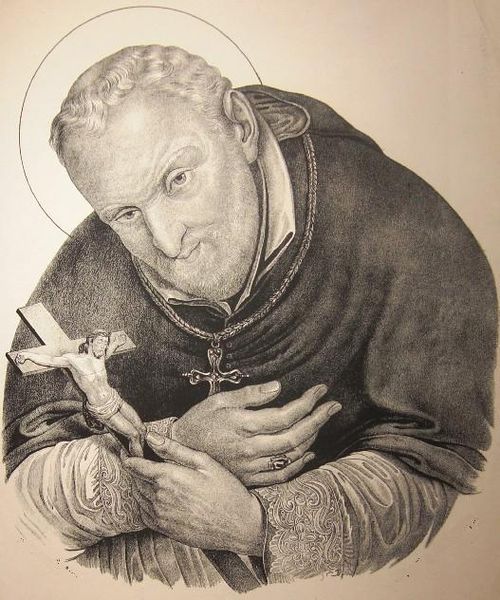
                      St Alphonsus Maria de Liguori (1696-1787)

      St Alphonsus, what a glory and what an example he is for the Italian clergy to study and venerate! We have been familiar with his life and works from the first years of our ecclesiastical training, and it is true that this great Doctor and Bishop whose spirit was to pass beyond the Alps and be miraculously spread abroad after his death, producing a wonderful flowering of apostleship and holiness, presents in his beloved person all that best corresponds to the genius of Italy, alert, shrewd, full of common sense and at the same time full of liberty, substance and poetry.

      Father Francesco Pitocchi knew his St Alphonsus, loved him and led others to know and love him with a fervour which aroused admiration. From his lips there flowed with astonishing facility episodes and details of the great Saint’s life, which he knew how to produce at the right moment, as examples and encouragements for us in the various events of our lives: he would repeat to us thoughts and words taken from his writings, which he always kept by him and advised us to read frequently.
      
      He used to say that St Alphonsus never grows old, and that his simple, modest writings contain inexhaustible treasures of doctrine, of sacred learning and that wisdom which is eternal and the very sap of holiness.

      He had great respect for other religious institutes, especially the Jesuits who had been the teachers of his youth, but he always felt himself to be heart and soul, a Redemptorist, content with his vocation for which he was thankful to God; faithful to the point of scrupulous self-sacrifice to his Rule and enthusiastic about his Congregation. He loved to tell us its good works, the glories of its apostolate throughout Europe and in the foreign Missions, and the old and new fruits of its learning and its work for the sanctification of souls.

      The secret of the attraction which Father Francesco exerted on everyone around him, and even on those who only met him once, lay in his truly fatherly character and the way in which he at once interested himself in everyone’s needs, as well as in his great discretion, his gentle, patient charity and his unalterable calm.
Discretion is the most important quality of a director of souls. The possession of it is a great gift of God: a gift that is granted to few.
Father Francesco had this gift in the highest degree.  Without any of those searching enquiries that disconcert the penitent, but with the immediate intuition of the man of God, he knew at once how to understand the moral character of whoever came to him, and to see to the depths of his soul. After knowing him for a month or two he knew all about a young man’s past and present: even the future was apparent to his clear gaze.

      We understood this: he read our eyes, he read our hearts. And our hearts opened to him spontaneously; we felt we had to tell him everything, interest him even in the smallest things; and so it happened that his advice and direction quietly and sweetly permeated the whole of our life in its various manifestations and interrelations: pious practices, studies, physical health, success and failures, happy or melancholy adventures, everything. For every problem or event he had the right word, the advice, the corrective, the comfort. He was admirable in adapting his ministry to the various characters and the variety of circumstances. Everyone seemed to draw from him all that he needed and that which was right for him.

      The two years in which I was able to profit from frequent and continuous contact with Father Francesco, were difficult years for young seminarists, in so far as the wind of modernity, sometimes impetuous and at other times gentle and caressing, which was later to degenerate, in part, into so-called Modernism, was blowing almost everywhere, and was to poison the heart and soul of many; especially during the first months it was a temptation to everyone. We students were so fortunate, for so long as we stayed with Father Francesco we were in no danger of being seduced by dangerous novelties. His great spirit of discretion, averse to all extremes, knew how to withhold consent from all that was uncertain, imprudent or insufficiently examined. He was intent above all on establishing in the consciences he directed the superior and balanced judgement that would make us shun futile arguments, thus teaching us the wise art of proceeding from words to things, from learning to life, to the life of priests and apostles.

      And his charity, St Paul’s ‘charity of God’, how it shone in Father Francesco’s eyes, on his smiling lips, in his whole person! To go and open one’s heart to him, and feel at once his response, warm with fatherly tenderness, took but a moment. And his kindness was expressed in patience, the long-suffering of Christ, an endless bearing of our troubles and indiscretions, a sweetness which was not sentimental but sober and dignified, which tempered correction, rendering it more acceptable. His words were serious and stern when necessary, and in days of gladness as in days of uncertainty and trouble, he found refinements and a warmth of speech the memory of which still moves me.

      What memories I have of August 11, 1904, when as a newly ordained priest I returned from Rome to say my second Mass: the whole villa lit up, the seminarists waiting to meet me, the welcome from my Superiors, always too kind and indulgent towards me, but most of all I remember the first priestly embrace of Father Francesco.

       In December that year he insisted that I make my first attempt to preach in public. It was to be on the feast of the Immaculate Conception, the fiftieth anniversary of that dogma, and it was to the Children of Mary in Our Lady’s chapel at San Gioacchino. I wrote everything down, and on the preceding evening recited it all to my Father, on my knees, after confession. He listened to me, smiling kindly and encouraging me.

      The next day, complete failure!  I was at once put off by the general atmosphere which to me, a countryman, seemed too aristocratic. I lost my presence of mind, my fluency, my fervour; I even lost my way in my own manuscript: I confused the New Testament with the Old, the witness of the Doctors of the Church with the imagery of the prophets, St Alphonsus with St Bernard, the middle with the beginning, and the beginning with the end: in short, a disaster!  When I had finished and tore myself away from that altar, I was like a shipwrecked man cast up on a shore, completely lost.

      Once in the presence of Father Francesco, in his little room near the sacristy, he encouraged me with such kindness in his bearing and his words, that in the end I was content to have suffered that mortification, which he made me offer to Our Lady, with a resolve to attempt another public sermon as soon as possible.
(to be continued)

From ‘Journal of a Soul’ by  Pope John XXIII
Four Square Editions 1966


                        Pope John XXIII - Papal Coat of Arms

                                   *************************

'The cross of the wicked thief, endured with impatience, became to him a precipice leading to hell; while the cross endured with patience by the good thief,  became to him a ladder to paradise'
('Thoughts from St Alphonsus' compiled by Rev C S Neiry C.SS.R  -  Burnes, Oates,Washbourne 1927)

'O Holy Mary, Mother of God, guide and protect thy people, especially our Holy Father, Pope Benedict XVI'

Tuesday, 1 February 2011

Illustrissimi - letter to GK Chesterton. 'Our Lady Vulnerata' at Valladolid


 Here is a further short extract from 'Illustrissimi',  the letters of  Albino Luciani, Patriarch of Venice, written in the early 1970s for the Italian Christian paper 'Il Messagero di Sant' Antonio'.In 1978 Albino Luciani was elected Pope, taking the name John Paul I. After only 33 days in office, he died of a heart attack.In these letters the author addresses well-known persons, both real and imaginary, expounding on their lives and experiences, and using these to illustrate God's love for mankind in spite of our weakness and sinfulness, and the need to live our lives in accordance with His laws and the laws of His Church. This letter is to G.K.Chesterton, English journalist and author (1874-1936), a convert to Catholicism in 1922. He wrote many novels and was a brilliant polemicist, who longed for an ideal society without social inequalities, based on good sense, religion, and humour. His works include 'The Napoleon of Notting Hill','The Man WhoWas Thursday', and the 'Father Brown Stories'.


                   GILBERT KEITH CHESTERTON (1874-1936)

Dear Chesterton,
       On Italian television during the past few weeks we have been seeing Father Brown, your surprising detective-priest – a character who is typically yours. A pity we haven’t also had Professor Lucifer and the monk Michael. I’d very much liked to have seen them as you described them in ‘The Ball and the Cross’, sitting beside each other on the flying ship.
   
               ' When the flying ship is above St Paul’s Cathedral, the Professor gives ‘a shriek indescribable’ as they pass the 'cross on the ball' set on top of the dome.
    “I once knew a man like you, Lucifer,” says Michael, "this man also took the view that the symbol of Christianity was a symbol of savagery and all unreason. His history is rather farcical. It is also a perfect allegory of what happens to rationalists like yourself. 
     He began, of course, by refusing to allow a crucifix in his house, or round his wife’s neck, or even in a picture. He said, as you say, that it was an arbitrary and fantastic shape, that it was a monstrosity, loved because it was paradoxical. Then he began to grow fiercer and more eccentric; he would batter the crosses by the roadside; for he lived in a Roman Catholic country. Finally in a height of frenzy, he climbed the steeple of the Parish church and tore down the cross, waving it in the air, and uttering wild soliloquies up there under the stars.
       Then one still summer evening as he was wending his way homewards, along a lane, the devil of his madness came upon him with a violence and transfiguration which changes the world. He was standing smoking for a moment, in front of an interminable line of palings, when his eyes were opened. Not a light shifted, not a leaf stirred, but he saw as if by a sudden change in the eyesight, that this paling was an army of innumerable crosses linked together over hill and dale. And he whirled up his heavy stick, and went at it as if at an army. Mile after mile along his homeward path he broke it down and tore it up For he hated the cross and every paling is a wall of crosses. 
      When he returned to his house he was a literal madman. He sat upon a chair and then started up from it, for the crossbars of the carpentry repeated the intolerable image. He flung himself upon a bed only to remember that this too, like all workmanlike things, was constructed on the accursed plan. He broke his furniture because it was made of crosses. He burnt his house because it was made of crosses. 
     He was found in the river.”
  
      Lucifer was looking at him with a bitten lip. “Is that story really true?” he asked. “Oh no,” said Michael, “It is a parable. It is a parable of you and all your rationalists. You begin by breaking up the Cross; but you end by breaking up the habitable world.”
    The monk’s conclusion, which is yours, dear Chesterton, is quite right. Take God away and what is left, what do men become? What sort of world are we reduced to living in?
    ‘Why, the world of progress!‘ I hear someone say, ‘the world of affluence!’  Yes but this famous progress isn’t all it was once cracked up to be. It contains other things in itself:  missiles, bacteriological and atomic weapons, the process of pollution, all things that unless they are dealt with in time, threaten to plunge the whole human race into catastrophe.
    In other words, progress that involves men who love one another, thinking of themselves as brothers and as children of the one Father, God, can be a magnificent thing. But progress that involves men who don’t recognise a single Father in God, becomes a constant danger: without a parallel moral progress, which is continuous and internal, it develops what is lowest and cruellest in man, making him a machine possessed by machines, a number manipulated by numbers; he becomes what Papini calls ‘a raving savage, who to satisfy his predatory, destructive and licentious instincts, no longer uses a club, but has the immense forces of nature and mechanical invention to draw upon.’
    Yes I know there are plenty of people who think the opposite of this, who consider religion a consoling dream invented by oppressed people ….. who consider God as dead or dying…. ‘yet, dear Chesterton, you and I go down on our knees before a God who is more present than ever. Only he can give a satisfactory answer to the questions which, for everyone, are the most important of all; Who am I? Where did I come from? Where am I going?
    The sense of justice that lies in every man, whatever his faith, demands that the good we do and the evil we suffer should be rewarded, that the hunger of life found in everyone should be satisfied. Where and how, if there is no other life? And from whom, if not from God? And from what God, if not the one of whom St Francis de Sales wrote: ‘Do not fear God, who wishes you no harm, but love Him a great deal, who wishes you so much good.’
    What many people fight is not the true God but the false idea they have made of God. A God who protects the rich, who only asks and demands, who is jealous of our growing prosperity, who spies continuously on our sins from above to give himself the pleasure of punishing us.
    Dear Chesterton, you know God isn’t like that; you know that He is both good and just; the father of prodigal sons, who wishes them all to be, not sad and wretched, but great and free, and creators of their own destiny. Our God is not man’s rival, He wants us to be His friends, He has called us to share in His divine nature and in His eternal happiness. And He does not ask anything excessive of us: He is content with very little, because He knows quite well that we  haven’t got very much.’
                                                              
                                       *******************                                                
 I found the following interesting information on the website of the Royal English College, Valladolid, Spain, an English seminary founded in 1589 by the famous Jesuit priest, Fr Robert  Persons, to train priests for the English Missions. Twenty-seven former students are recognised as martyrs for the faith. The College is no longer used as a major seminary, due apparently to the decline in vocations, but it organises a 'propaedeutic' year ie. a preliminary year for priestly aspirants,  before they begin their full seminary training elsewhere.

                                                 
                OUR LADY VULNERATA (THE WOUNDED ONE)

The image of Our Lady venerated in the College Chapel, is that of La Vulnerata, or The Wounded One. The story of the Vulnerata goes back centuries; but in 1596, as Spain was recovering from the defeat of the Armada and was gathering another fleet in the city of Cadiz, the Earl of Essex together with Sir Walter Raleigh led an English fleet into the harbour, defeating the Spanish fleet and taking possession of the city. Some of the English troops started a riot and dragged a statue of the Virgin Mother and Child from a church to the market square, where they desecrated it. They broke off both arms, and all that remained of the child were parts of his tiny feet on his mother’s knee. The mutilated statue was later retrieved, taken to Madrid, and given a place of honour in a private chapel of a Countess. 
               The priests and seminarians of the English and Welsh College in Valladolid asked the Countess if they might make reparation for the behaviour of their fellow countrymen who had desecrated the statue. She agreed and the statue was brought to Valladolid and installed with great solemnity in the College Chapel in 1600. Every year during Holy Week the statue is processed along the street, where it is met by a huge 'paso' or float, which has a large depiction of the Crucified Christ resting on top of it. The two images meet, and dance to each other for a brief period--then the Vulnerata comes back to the College.

Prayer to Our Lady Vulnerata

Dear Mother, as I gaze on your wounded and mutilated image, I humbly beg your pardon for the grievous insults to you, great Mother of God. Help me to notice the wounded children of the world, and see your beauty in the faces of the poor and disfranchised. Let me love them better, as your Son commanded. I praise you through the faith, loyalty and blood of the missionaries who prayed for courage before your image, and I ask you to keep today’s missionaries in your loving care as they, too, carry the Good News throughout the world. Amen
                        
                            ***************************** 

Holy Mary, Mother of God, pray for us, and guide and protect our Holy Father, Pope Benedict XVI.

Tuesday, 28 December 2010

'Illustrissimi' by Albino Luciani - Letter to St Therese of Liseux


    Albino Luciani was born in 1912 in the small village of Forni di Canale (now known as Canale d'Agordo),situated between Venice and the Italian border with Austria.
             He studied at the seminary of Belluno, was ordained in 1935, and was then sent to the Gregorian University in Rome where he took a degree in theology. After several years teaching theology at the Belluno seminary, Luciani was appointed Vicar General of Belluno in 1948, and ten years later Pope John XXIII, who thought very highly of him, named him Bishop of Vittorio Veneto.  In 1969 he became Patriarch of Venice, and on 5th March 1973 Pope Paul VI made him a cardinal.
             On the death of Pope Paul, Albino Luciani was elected Pope on 26 August 1978, taking the name John Paul in honour of his two immediate predecessors.
              After only 33 days in office, Pope John Paul I died of a heart attack during the evening of 28 September 1978.

                              
                                           Pope John Paul I

 The ‘Illustrissimi’ (the Letters) by Albino Luciani, were written  between the years 1969 and 1978 when he was Patriarch of Venice, and were published in the Italian Christian paper ‘Il Messagero di Sant Antonio’. The letters are addressed to various individuals, some fictional, some historical. He writes to legendary figures, to important scientific, historical and literal people, to characters from their books, plays, operas, poems, to saints and even to Christ himself. If the recipients are varied, the subjects he discusses with them are even more so. Although addressed to  many different characters, and related directly to their particular interests, the letters were meant for the ordinary person living in the 1970’s. They were written as a teaching device, as a means of proclaiming the gospel, of opening people’s minds and hearts anew to the message of Christianity.
          The papacy of Pope John Paul I lasted only 33 days, allowing little time for him to become known to his flock either in his public appearances or in his writings. However these letters reveal some of the character of the writer, a man rooted in the Gospel, but with his feet firmly on 20th century ground, calmly surveying the contemporary, tempestuous and troubled world, smiling at its absurdities, regretting its evil, and rejoicing in its good. A man firm in faith, hope and charity; humorous when musing on the follies and frivolities of people, yet firm in maintaining Christian ethics and moral standards. A man who understood people from within and who identified with them, yet a man to whom his faith was the breath of life and the source of joy.     (Basil Hume OSB, Cardinal Archbishop of Westminster.  October 1978)

Letter to St Therese of Liseux.
Dear Little Therese,
I was seventeen when I read your autobiography.
It struck me forcibly. You called it ‘The story of a little flower’. To me the will-power, courage and decisiveness it showed made it seem more like the story of a piece of steel. Once you had chosen the path of complete dedication to God, nothing could stop you: not illness, nor opposition from outside, nor inner confusion and darkness.
    I remember the time I was ill and sent to a sanatorium, in the days before penicillin and antibiotics, when death awaited pretty well anyone who was sent to hospital.
    I was ashamed of myself for feeling a little afraid. ‘At the age of twenty-three,’ I said to myself, ‘Therese, who until then had been healthy and full of vitality, was filled with joy and hope when she first spat blood. Not only that, but when her health improved, she got permission to end her fast with a diet of dry bread and water. And you’re almost trembling! You’re a priest! Don’t be silly!

                                 *********************

Reading it again, on the centenary of your birth (1873 to 1973), what now strikes me most is the way in which you loved God and your neighbour.  St Augustine wrote: ‘We reach God, not by walking, but through love.’ You also called your road ‘the way of love’. Christ said: ‘No one comes to me unless my Father calls him’. You were perfectly in tune with these words, feeling ‘like a bird without strength and without wings’, and seeing in God an eagle who came down to carry you off on high, on its wings. You called divine grace ‘the lifter’, which carried you to God swiftly and easily, since you were ‘too small to climb the harsh ladder of perfection’.
    I said ’easily’, but let me make it clear: I meant it only in one way. In another …..,.. well in the final months of your life your soul felt as if it was going down a kind of dark passage, seeing nothing of what it had once seen clearly. ‘Faith’, you wrote, ‘is no longer a veil but a wall’. Your physical sufferings were so great that you said, ‘If I had not had faith, I would have chosen death’. In spite of that you kept saying to the Lord you loved, saying with your will alone, ‘I sing of the happiness of Paradise, but without any feeling of joy; I sing simply because I want to believe’. Your last words were: ‘My God, I love You’.
    To the merciful love of God you offered yourself as a victim. All this did not prevent you from enjoying what was good and beautiful. Before your final illness you loved painting, and wrote poetry and short plays on religious subjects, taking some of the parts yourself and showing quite a talent for acting. In the last stage of your illness, when you felt briefly better, you asked for some chocolates. You had no fear of your own imperfections, not even of having sometimes slept during meditation, out of weariness (‘mothers love their children, even when they are asleep’).
    Loving your neighbour, you tried to serve others in small, useful ways, but to do so unobserved; and you preferred, if anything, to do this for people who irritated you, those you understood least. Behind their un-likeable faces you sought the beloved face of Christ. And no-one noticed these efforts of yours. ‘How mystical she was in chapel, and at her work’, the prioress wrote of you, ‘At other times she was very amusing, full of fun and making us laugh uproariously at recreation’.
    Joy mixed with Christian love appears in the song of the angels at Bethlehem. It is part of the essence of the Gospel which means ‘good news’. It is characteristic of the saints. Joy may become perfect charity if it is shared, as in fact, dear St Therese, you shared yours at recreation in the convent.
    Therese, the love you gave God (and your neighbour for love of God) was really worthy of Him. This is how our love should be: a flame fed by all that’s great and fine in ourselves; a rejection of all that is refractory in us; and a victory that carries us on its wings and takes us as a gift to the feet of God.
    These few lines certainly don’t contain the whole of your message to Christians, but they are enough to point out a few things to us.

(From ‘Illustrissimi by Albino Luciani. The Letters of Pope John Paul I, published by Collins, Fount Paperbacks, 1979)

                                ***************

 'The Little Way'  by  St Therese of Liseux

 "Sometimes, when I read spiritual treatises in which perfection is shown with a thousand obstacles, surrounded by a crowd of illusions, my poor little mind quickly tires. I close the learned book which is breaking my head and drying up my heart, and I take up Holy Scripture. Then all seems luminous to me; a single word uncovers for my soul infinite horizons; perfection seems simple; I see that it is enough to recognize one's nothingness and to abandon oneself, like a child, into God's arms. Leaving to great souls, to great minds, the beautiful books I cannot understand, I rejoice to be little because 'only children, and those who are like them, will be admitted to the heavenly banquet.' " 

"For me, prayer is a movement of the heart; it is a simple glance toward Heaven; it is a cry of gratitude and love in times of trial as well as in times of joy; finally, it is something great, supernatural, which expands my soul and unites me to Jesus. . . . I have not the courage to look through books for beautiful prayers.... I do like a child who does not know how to read; I say very simply to God what I want to say, and He always understands me."


                                         St Therese of Liseux
 
"Love proves itself by deeds, so how am I to show my love? Great deeds are forbidden me. The only way I can prove my love is by scattering flowers and these flowers are every little sacrifice, every glance and word, and the doing of the least actions for love."

                                   *******************
Today is the feast day of the Holy Innocents, massacred by order of  King Herod, intended to kill  the Child Jesus.  O Holy Innocents pray for us and for our Country, and we particularly ask your prayers that  legalised abortion  be recognised for the evil that it is, and banished from the Statute book.

Our Blessed Lady, Cause of Our Joy, guide and protect our Holy Father Pope Benedict XVI.